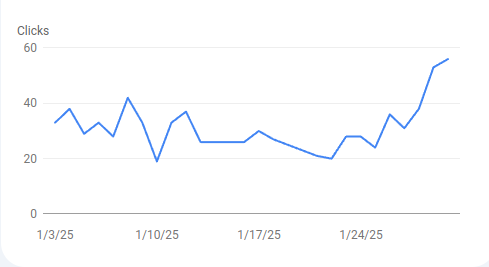
Do you want to see something like this in your stats?
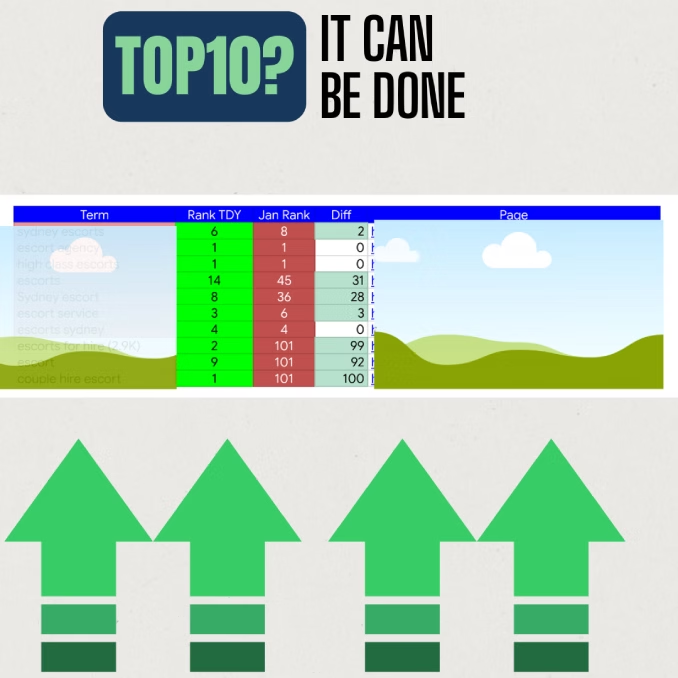
Are Your Pages Ranking or not?
Are you tired of slogging away to improve the ranking of your site without anything actually happening? What if I told you that with this technique, you can rightly reach the first page of Google without link building, guest blogging, or relying on antiquated SEO hacks? This is the content-first ranking method that offers a fresh perspective outside the confining walls of conventional SEO wisdom, but delivers only what matters-value-driven and user-centric content.
To get enough traffic you need to be found online. The avenue to achieve that can be two to three possibilities: 1. Your pages rank high enough in search and generate huge traffic. This option very rarely works. 2. You spent obscene amounts of money each month to get your offer in front of -hopefully- interested people. 3. You have found a sub-niche online community and your posts generate hundreds of views and clicks (rare but totally possible).
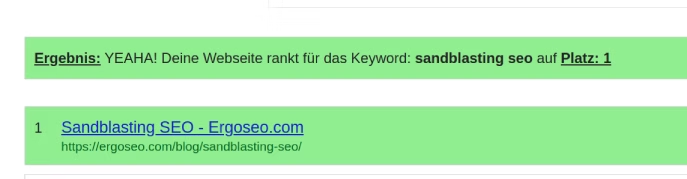
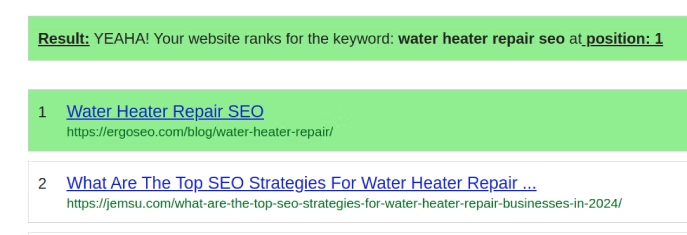
Here’s a #1 result I’ve achieved with this content-ranking method.
Here is the Real Issue
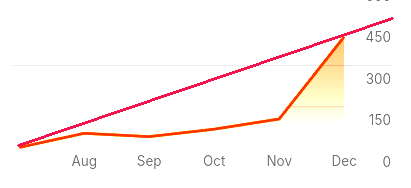
813% growth with this method in just 3 months (very competitive niche)
Zero Backlinks Does Not Automatically Mean Zero Authority
One important distinction gets lost whenever SEO discussions focus on whether a ranking page has backlinks. A page can have no external links pointing directly to it while still benefiting from the overall strength, history, and relevance of the website hosting it.
That means a screenshot showing a page ranking with zero backlinks is not automatically proof that the same result could be reproduced on a brand-new domain with no established authority.
This distinction matters when evaluating content-only SEO results. A page on an established website may already have strong internal links, a history of being crawled and indexed, established topical relevance, and other signals that a completely new website does not have.
There is also a difference between ranking for a low-competition long-tail query and competing against established websites for a highly competitive commercial term. Current examples of no-backlink rankings show that content can rank without links, but the circumstances behind those rankings matter. Some successful examples involve long-tail or relatively weak search results, while more competitive queries can still favor established sites with stronger authority.
CORS therefore should not be presented as a claim that backlinks have become irrelevant. The stronger argument is that a page does not automatically need a backlink campaign before it has a chance to rank.
The practical question is not simply whether a page has backlinks. It is whether the content is sufficiently relevant, useful, technically accessible, and competitive for the particular search query.
Why Traditional SEO Strategies Are Failing You
— User Intent Matching – Understanding exactly what users need and delivering it.
— Semantic Relevance – Providing deep, interconnected content that satisfies queries.
— Engagement Metrics – Getting users to stay on your page longer, interact, and take action.
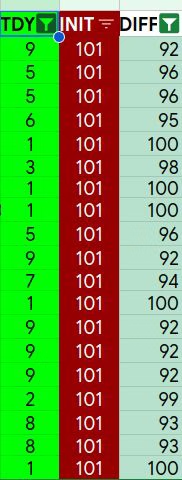
Rankings jump to the top 10
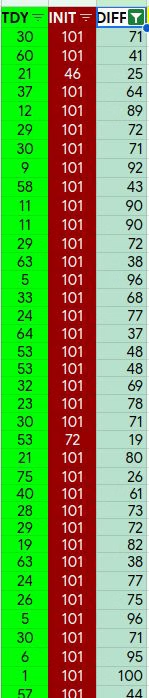
Rankings jump in top 100
The Content-Only Ranking System (CORS)
The method I describe utilizes Google advancements and natural language processing. Let’s get into the particulars of what makes CORS exceptional and your secret key to attaining a position among the top 10.
Start With the Existing Website, Not a Blank Content Calendar
A content-only strategy does not have to mean publishing hundreds of new articles. In many cases, the existing website is the better place to start.
A business may already have pages sitting on page two, three, or even lower in Google that are relevant to valuable searches. Those pages have already been published, indexed, and associated with a particular subject. Reworking them can be more useful than continually adding new articles without examining what is already there.
The first step is to identify pages that have impressions but are not receiving enough clicks, pages ranking just outside the first page, pages attracting traffic for related searches, and pages that overlap with other content on the same website.
The next step is to determine why those pages are underperforming. The problem could be weak search-intent alignment, incomplete topical coverage, poor page structure, weak internal linking, outdated information, or a technical issue affecting accessibility.
This also prevents a common content strategy mistake: publishing more material simply because traffic has stalled. More pages do not automatically solve a relevance or optimization problem.
A content-only system should therefore treat existing content as an asset to be analyzed and improved. New content has its place, but the objective is to make the website’s existing topical coverage work harder before assuming that another article is the answer.
1. Building Advanced Topical Authority
— Pillar & Cluster Strategy – make it a very close set of related articles and interlinking naturally.
— Comprehensive Content Siloing – structure your content in such a way that is a breeze for the user to navigate.
— Answering All User Queries – not leaving any unanswered questions within the niche.
2. Optimization is directed towards Natural Language Processing (NLP).
— Semantic Keyword Integration – Incorporate an NLP-based keyword research tool that finds the related terms and concepts.
— Entity-Based Optimization – Mention some key entities, topics, and relationships relevant to your industry that Google associates with your niche.
— Conversational Flow – Like a natural, engaging flow of writing shouldn’t get hardened by the forced imposition of keywords.
3. Behavioral SEO: Content that Grabs Attention
User engagement is one of the most influential ranking factors. Google is tracking parameters like bounce rate, dwell time, and even CTR. In order to optimize these totally:
— Headlines & Meta Descriptions That Grab Attention-Make your CTR soar with irresistible hooks.
— Content that Is Long Yet Very Scannable – Using subheadings, bullet points, and visuals for easy reference.
— Useful Internal Links – Keep users meandering through your site with a natural flow.
4. Search Intent Mastery: The Google Magnet Effect
Not all search queries are the same. To rank in the top 10, you need to align your content with user intent:
— Informational Queries – Blog posts, ultimate guides, and FAQs.
— Navigational Queries – Brand comparisons, case studies, and resources.
— Transactional Queries – Conversion-focused landing pages with persuasive copy.
5. Real Time Refreshing for Content: The Freshness Factor
Google likes fresh content. Here is the advantage that you can take:
— Updating Content Periodically – Refreshing old articles using new data and insight.
— Live Testing of Content – Track user behavior and adjust pages.
— Content Velocity – Redirect and maintain a publishing schedule to show Google that you are actually active.
Know When Content Alone Has Reached Its Limit
A content-only strategy needs a clear understanding of competition. Ranking without deliberately building backlinks is possible, but that does not mean content alone will overcome every competitive advantage held by the pages already occupying the search results.
Current examples of no-backlink rankings repeatedly point toward the same limitation. Content-only approaches are particularly viable for long-tail and lower-competition searches, while highly competitive commercial terms and search results dominated by established brands can present a much harder problem.
This is where search-result analysis becomes more important than a keyword difficulty score. Look at the actual pages ranking for the query. Examine how closely they match the search intent, how comprehensively they cover the subject, how strong their site structure is, and whether the results are dominated by well-established websites.
If a page moves from position 60 to position 15 after content improvements, that is useful evidence that relevance and optimization are helping. If it then stops moving despite further improvements while highly established competitors occupy the top positions, continuing to rewrite the same page indefinitely may not produce another breakthrough.
CORS should therefore include a stopping point. Content optimization should be tested against the actual search results, measured over time, and evaluated according to how much room remains for improvement.
The objective is not to prove that backlinks are unnecessary in every possible search. The objective is to determine how far a website can move through better content, stronger topical coverage, better internal structure, and closer alignment with search intent before another source of authority becomes necessary.
Case Study: Ranking Without a Single Backlink
— They structured their site with topical clusters and content optimization based on user behavior and NLP.
— Their major are being precise and purpose-driven to a fault in matching user search intent.
— They improved the content constantly through analytics.
With this, they achieved a 300% increase in organic traffic without any link-building campaigns.
Content-Centric Future of Google
Google is moving into the AI era, and in doing so is giving user experience and content quality precedence over older ranking factors. If you adopt a content-first approach today, you will keep your rankings protected from algorithm updates in the far future that punish link-based manipulations.
Create Your Content Only Ranking
So, want to rank within Google’s top 10 without backlinks? Follow these:
— Research topical clusters in your niche, and start building authority.
— Semantically rich, user preferred, and intent-driven content.
— Behavioral SEO for optimizing engagement metrics.
— Frequently refresh ongoing and updated content for continued rankings.
— Monitor performance adjustments in real-time data.
Are you ready to implement CORS and watch your rankings soar? Start today!
— Up to 1,000 monthly searches
— Easier wins, faster traction
— From 1,000 up to 10,000 monthly searches
— More competitive terms, broader visibility
— Highly competitive markets and major keywords
— 10,001+ monthly searches with no upper limit.